Is Buying an Investment Property in Silicon Valley Still Worth It in 2026?
Real estate investing hasn’t disappeared in Silicon Valley, but today’s market requires a more thoughtful approach to purchasing, financing, and long-term ownership.
For years, purchasing an investment property was widely viewed as a reliable way to build wealth. Investors could generate rental income, benefit from property appreciation, and potentially grow their real estate portfolios over time.
But the housing market has changed.
Higher borrowing costs than those seen during the pandemic-era low-rate environment, elevated property prices, insurance expenses, and ongoing maintenance obligations have made investment property decisions more complex.
In Silicon Valley, where purchasing a home often requires a substantial financial commitment, these considerations are especially important.
That doesn’t necessarily mean buying an investment property is no longer worthwhile.
It means investors need to be more selective about what they buy, how much they pay, what the property can realistically earn, and how much it will cost to own.
Whether you’re considering your first rental property or expanding an existing portfolio, understanding the local market is an essential starting point.
Is Real Estate Still a Good Investment in Silicon Valley?
Silicon Valley remains a distinctive real estate market because of its employment centers, established neighborhoods, educational institutions, and long-term housing demand.
Communities such as San Jose, Santa Clara, Sunnyvale, Mountain View, Cupertino, Los Gatos, and Saratoga attract residents with different housing needs and budgets.
For investors, that creates opportunities across several property types, including:
- Single-family rental homes.
- Condominiums and townhomes.
- Duplexes and other small multifamily properties.
- Homes with permitted accessory dwelling units (ADUs).
- Properties that may offer long-term redevelopment or improvement potential.
However, a desirable location doesn’t automatically make a property a profitable investment.
A home may attract strong tenant interest while still generating negative monthly cash flow because of its purchase price, financing costs, and ongoing expenses.
The key is to evaluate the individual property’s financial performance rather than assume that every Silicon Valley property will appreciate or generate sufficient rental income.
Why Investment Property Buyers Need a Different Strategy in 2026:
During periods of rapid home price appreciation and unusually low mortgage rates, some investors could justify purchases based partly on expectations of rising property values.
Today’s investment decisions require more conservative assumptions. Investors should carefully consider several factors.
1. Higher Financing Costs Can Reduce Cash Flow:
Mortgage financing is one of the largest expenses associated with purchasing a rental property.
Loans for non-owner-occupied investment properties often have different pricing, down payment requirements, and underwriting standards than mortgages for primary residences.
Even a relatively small difference in interest rates can significantly affect monthly payments on a high-value Silicon Valley property.
For example, consider a hypothetical $1 million investment property purchased with a 25% down payment.
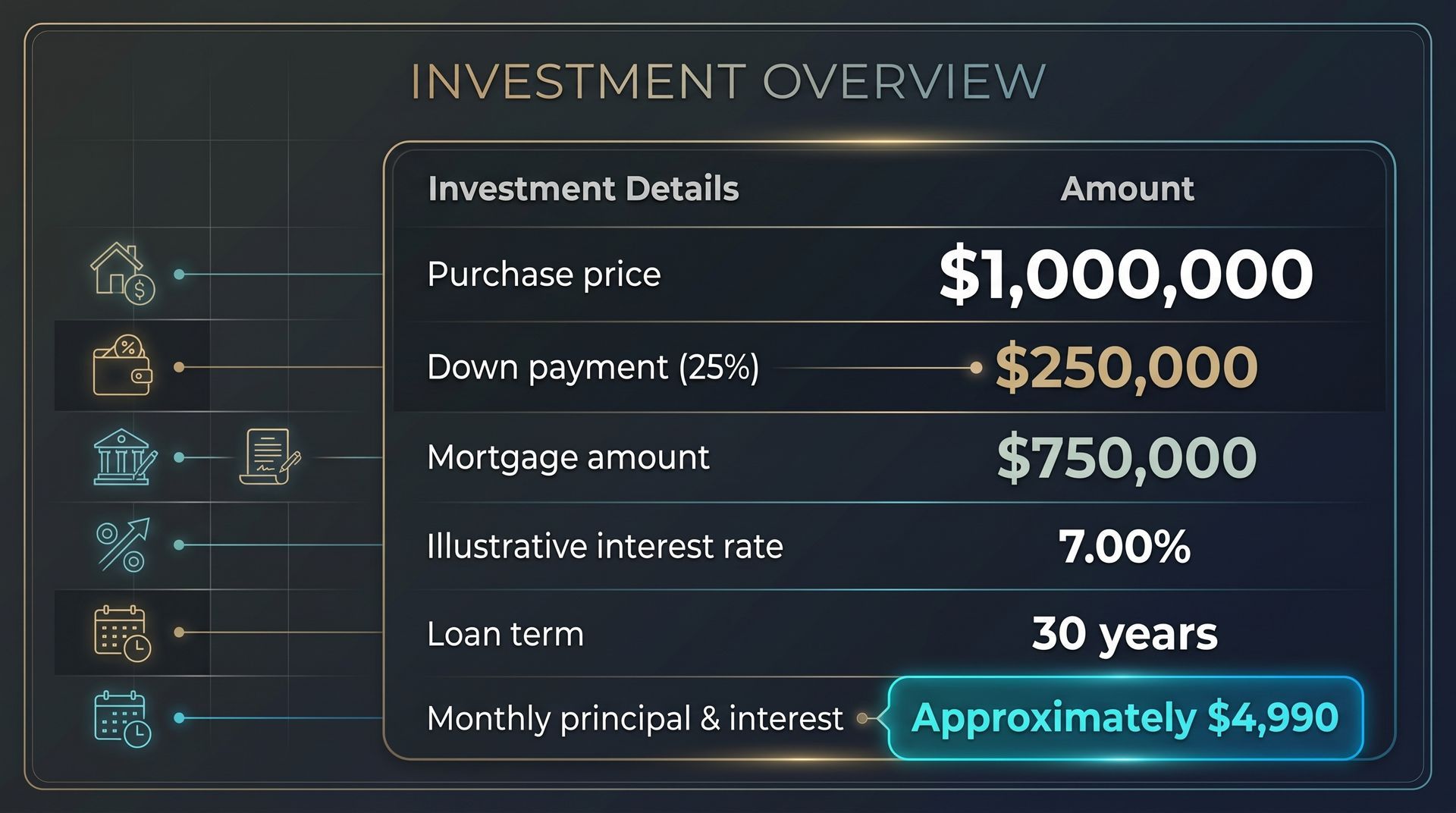
Before collecting any rental income, the investor would already have a substantial monthly mortgage obligation.
And that is only the beginning of the property’s operating costs.
This is why investors should obtain financing estimates early and evaluate the complete financial picture before making an offer.
2. Property Taxes and Insurance Matter
California’s property tax system differs from those in many other states.
Under Proposition 13, the base property tax assessment for a newly purchased property is generally established using its acquisition value, subject to applicable rules and adjustments.
The base property tax rate is generally 1%, but voter-approved indebtedness and certain additional assessments can increase the total bill.
For investors, this means the seller’s existing property tax bill may not accurately represent what the buyer will pay after purchasing the property.
Insurance expenses also deserve attention.
Coverage costs can vary depending on the property’s location, age, construction characteristics, and other risk factors.
A rental property may require landlord insurance rather than a standard owner-occupied homeowners policy.
Obtaining property-specific insurance estimates before purchasing can help investors avoid unexpected expenses.
3. Maintenance and Vacancy Expenses Can Affect Returns:
Rental income isn’t guaranteed every month.
Properties may experience vacancies between tenants, unexpected repairs, or larger maintenance expenses.
A roof replacement, plumbing problem, appliance failure, or major system repair can significantly affect annual returns.
Investors should therefore budget for both routine maintenance and less predictable expenses.
A property that appears profitable only when fully occupied and operating without repairs may expose its owner to unnecessary financial risk.
The Numbers Every Silicon Valley Property
Investor Should Review:
One of the most important steps in evaluating an investment property is understanding its potential cash flow.
How Do You Calculate Rental Property Cash Flow?
A basic rental property cash flow analysis starts with expected rental income and subtracts the property’s operating expenses and debt payments.
Consider this simplified hypothetical example:
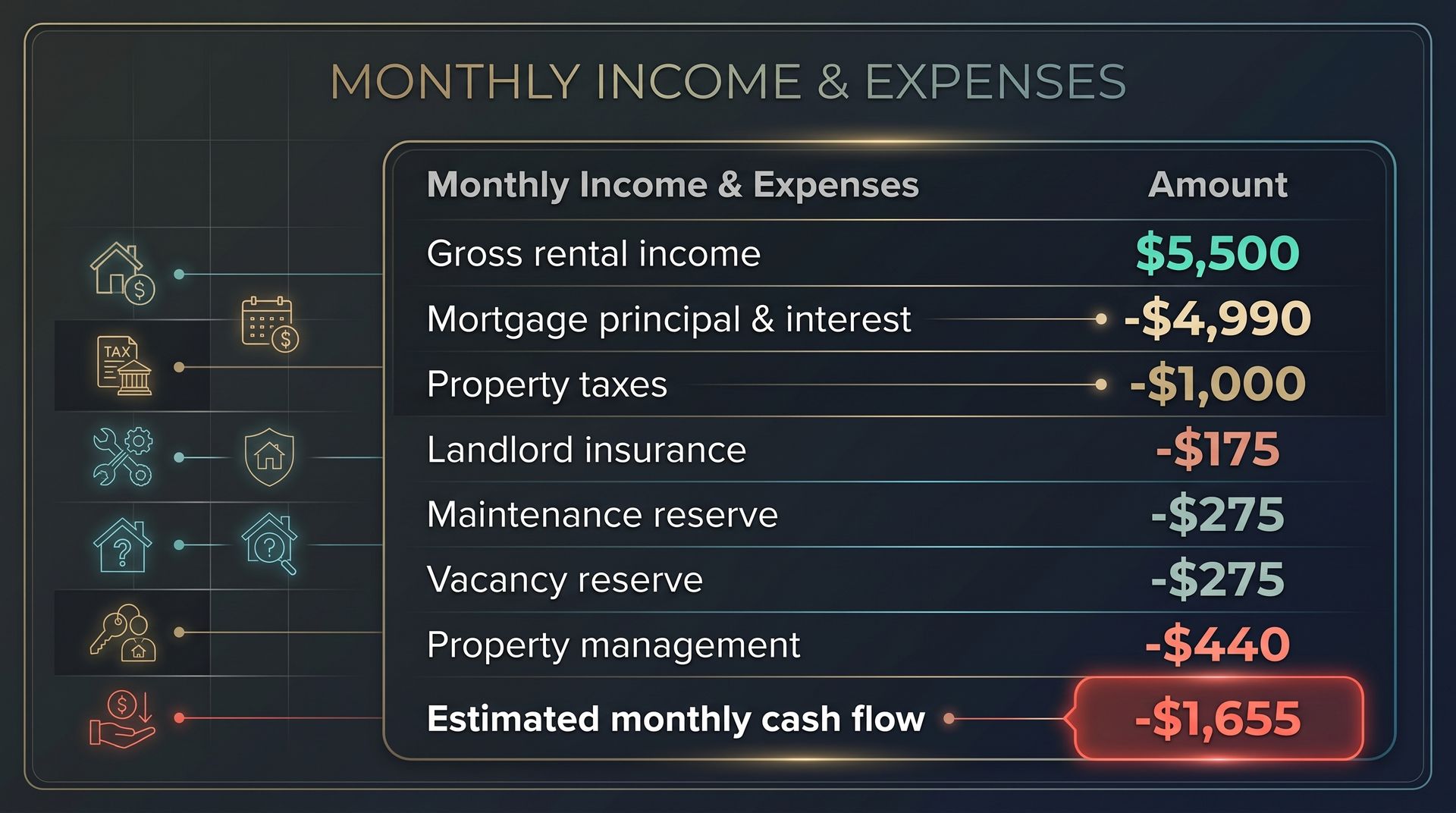
In this scenario, the property would generate approximately $1,655 in negative monthly cash flow before any additional expenses not included in the example.
That doesn’t necessarily mean the property could never be a suitable investment.
Some investors may accept negative cash flow in pursuit of other objectives, such as long-term appreciation or principal repayment.
However, those potential benefits are uncertain and should not be treated as guaranteed returns.
The example illustrates why a property’s purchase price and realistic rental income must be evaluated together.
What Is Cap Rate?
Another common metric used to evaluate rental properties is the capitalization rate, or cap rate.
Cap rate compares a property’s annual net operating income with its purchase price or current market value.
Net operating income generally includes rental revenue minus operating expenses, but excludes mortgage principal and interest payments.
A cap rate can help investors compare certain properties, although it doesn’t account for financing costs or every aspect of an investment’s potential return.
In Silicon Valley, investors should be particularly careful when comparing cap rates across different property types and neighborhoods.
A condominium, duplex, and single-family home may have very different operating expenses, maintenance obligations, and rental characteristics.
Why Purchase Price Matters More Than Ever:
One of the few major investment variables a buyer can influence directly is the price paid for the property.
A lower purchase price can potentially reduce the amount financed, the cash required upfront, and the property’s ongoing financial burden.
However, finding a property listed below nearby comparable homes doesn’t automatically make it a bargain.
Investors should determine why the property is priced differently.
Possible explanations include:
- Deferred maintenance or necessary repairs.
- Less desirable location or property features.
- HOA restrictions or high association dues.
- Unpermitted improvements.
- Tenant occupancy or lease-related considerations.
- Financing or insurance complications.
An experienced local Realtor can help investors evaluate comparable sales, property condition, neighborhood demand, and pricing patterns before deciding whether an opportunity deserves further consideration.
In a market as varied as Silicon Valley, the right purchase price depends on the specific property—not simply whether it appears less expensive than other listings.
Which Silicon Valley Properties May Appeal to Investors?
Different investment strategies may work better with different property types.
Single-Family Rental Homes
Single-family homes can appeal to tenants seeking additional space, privacy, and access to established residential neighborhoods.
However, detached homes in Silicon Valley often require substantial upfront capital.
Investors should carefully evaluate whether expected rental income can support the purchase price and ownership expenses.
Condominiums and Townhomes
Condos and townhomes may offer lower purchase prices than comparable detached homes.
They can also provide access to desirable neighborhoods and certain shared amenities.
However, HOA dues, rental restrictions, special assessments, and project financing considerations can affect an investment’s performance.
Before purchasing, investors should review the association’s governing documents, financial disclosures, insurance arrangements, and applicable rental policies.
Duplexes and Small Multifamily Properties
Properties with multiple rental units may provide more than one source of rental income.
For example, a duplex may allow an investor to collect rent from two separate households.
However, operating expenses, tenant management, maintenance responsibilities, and financing requirements must be evaluated carefully.
Investors should also confirm the property’s legal unit count and applicable local rental regulations.
Homes With Accessory Dwelling Units (ADUs)
Properties with permitted ADUs may be particularly interesting to certain Silicon Valley investors.
An ADU can potentially create an additional rental income opportunity while allowing the property to serve different household needs.
However, investors should verify that the unit is legally permitted, understand applicable rental restrictions, and determine whether the projected income is realistic.
For properties where an ADU might be added, construction costs, zoning requirements, utility connections, permitting, and project timelines must be considered.
Not every property is suitable for an ADU, and the potential rental income should be evaluated alongside the full cost of creating and maintaining the unit.
What About Buying an Investment Property
With Cash?
Purchasing a rental property with cash can eliminate mortgage payments and reduce exposure to interest-rate fluctuations.
This may improve monthly cash flow compared with a similarly priced financed purchase.
Cash buyers may also have greater flexibility in certain negotiations.
However, paying cash doesn’t eliminate ownership expenses.
Property taxes, insurance, maintenance, vacancies, and other operating costs remain.
A cash purchase also ties up capital that could otherwise be used for additional investments or financial needs.
For this reason, investors should compare the potential benefits of paying cash with the opportunity cost of using a substantial amount of available funds.
Financing may still make sense for some investors, depending on their financial position, investment objectives, and tolerance for risk.
California Landlord Regulations: What Investors Should Know
Buying a rental property in California involves legal responsibilities that extend beyond collecting rent and maintaining the home.
Investors should become familiar with applicable state and local landlord-tenant regulations before purchasing.
California Tenant Protection Act
California’s Tenant Protection Act, commonly associated with AB 1482, establishes rent increase limitations and just-cause eviction requirements for many covered residential rental properties.
However, exemptions and special conditions apply.
Some single-family homes, condominiums, newer properties, and other housing types may qualify for exemptions under specific circumstances.
Investors should not assume a property is exempt without confirming the applicable requirements.
Local Rent Stabilization and Tenant Protections
Certain Silicon Valley communities have local rental regulations that may impose additional requirements.
For example, San Jose has its own rent stabilization and tenant protection rules that apply to certain properties.
Other cities may have different ordinances or requirements.
The property’s location, age, ownership structure, and rental history can affect which regulations apply.
Because these rules can influence rental income, lease terms, and property management decisions, investors should consult qualified legal professionals when evaluating compliance.
Security Deposits and Other Requirements
California also regulates security deposits, habitability standards, notices, and other landlord responsibilities.
Under rules that took effect in 2024, most California residential landlords are generally limited to collecting a security deposit equivalent to one month’s rent, although certain qualifying small landlords may be eligible for an exception.
Investors should verify current requirements before entering into rental agreements.
Understanding these obligations early can help prevent unexpected complications after purchasing.
Should You Buy an Investment Property for Appreciation or Cash Flow?
This is one of the most important questions investors should consider.
Cash flow refers to the income remaining after paying the property’s operating expenses and debt obligations.
Appreciation refers to an increase in the property’s market value over time.
Both can contribute to an investment’s overall performance, but neither is guaranteed.
In high-cost markets such as Silicon Valley, some properties may offer limited immediate cash flow relative to their purchase prices.
Investors may therefore place greater emphasis on long-term ownership, potential appreciation, or other financial objectives.
However, relying entirely on future price increases can create substantial risk.
Property values can decline, market conditions can change, and selling a property involves transaction costs.
A disciplined investor should understand whether the property can be supported financially under less favorable conditions.
Five Questions to Ask Before Buying a Rental Property in Silicon Valley:
Before making an investment property purchase, consider the following questions.
1. What Rent Can the Property Realistically Generate?
Research comparable rental properties in the same neighborhood. Consider differences in size, condition, parking, amenities, and location.
Avoid basing projections solely on the highest advertised rents.
2. What Will the Property Cost to Own?
Estimate all major expenses, including financing, property taxes, insurance, maintenance, HOA dues, property management, and vacancy reserves.
3. What Happens If the Property Is Vacant?
Consider whether you could comfortably cover expenses during an extended vacancy or unexpected repair.
Maintaining adequate reserves can reduce financial pressure.
4. Are There Rental Restrictions or Legal Considerations?
Review applicable HOA rules, lease arrangements, tenant protections, and local regulations.
A property that appears attractive financially may have restrictions that affect how it can be rented.
5. Does the Investment Fit Your Long-Term Goals?
Consider whether you’re primarily seeking current income, long-term appreciation, portfolio diversification, or another objective.
Different strategies require different financial assumptions and risk considerations.
Why Working With a Local Silicon Valley
Realtor Matters:
Investment properties require a different evaluation process than homes purchased primarily for personal use.
Beyond the property’s appearance and location, investors must consider rental demand, operating expenses, property condition, financing, and future resale opportunities.
A knowledgeable local Realtor can help investors:
- Identify neighborhoods and property types aligned with their investment criteria.
- Evaluate comparable sales and current market pricing.
- Research relevant rental market conditions.
- Recognize property characteristics that may affect rental appeal.
- Identify important disclosures and due diligence considerations.
- Coordinate with lenders, inspectors, property managers, and other professionals.
- Develop a purchasing strategy based on local market conditions.
Scott Perry, an experienced Realtor serving Silicon Valley, helps buyers evaluate real estate opportunities throughout San Jose, Santa Clara, Los Gatos, Saratoga, and surrounding communities.
Whether you’re considering your first investment property, purchasing a home with an ADU, or exploring opportunities to expand your portfolio, local market knowledge can be an important part of your decision-making process.
A Realtor can provide valuable property and market guidance, while tax professionals, attorneys, lenders, and financial advisors can address questions within their respective specialties.
The Bottom Line: Is Buying an Investment Property Still Worth It?
Buying an investment property in Silicon Valley can still be worth considering in 2026, but success depends on more than simply purchasing a home and waiting for its value to increase.
Today’s investors need to evaluate purchase prices carefully, estimate rental income conservatively, understand ownership expenses, and prepare for potential financial challenges.
A property that looks appealing at first glance may not generate the returns an investor expects once all costs are considered.
On the other hand, a well-researched purchase that aligns with an investor’s financial goals may offer opportunities for long-term ownership and wealth building. The most important step is understanding the numbers before making a commitment.
If you’re exploring investment properties in Silicon Valley, working with an experienced local real estate professional can help you evaluate available opportunities and make more informed purchasing decisions.
Thinking about purchasing an investment property in Silicon Valley? Connect with Scott Perry to discuss local market conditions, explore available properties, and identify real estate opportunities that align with your goals.
Disclaimer: This article is intended for general educational purposes and does not constitute investment, legal, tax, or financial advice. Rental income, property values, expenses, and investment returns are not guaranteed. Investors should consult qualified professionals regarding their individual circumstances.
Recent Posts